

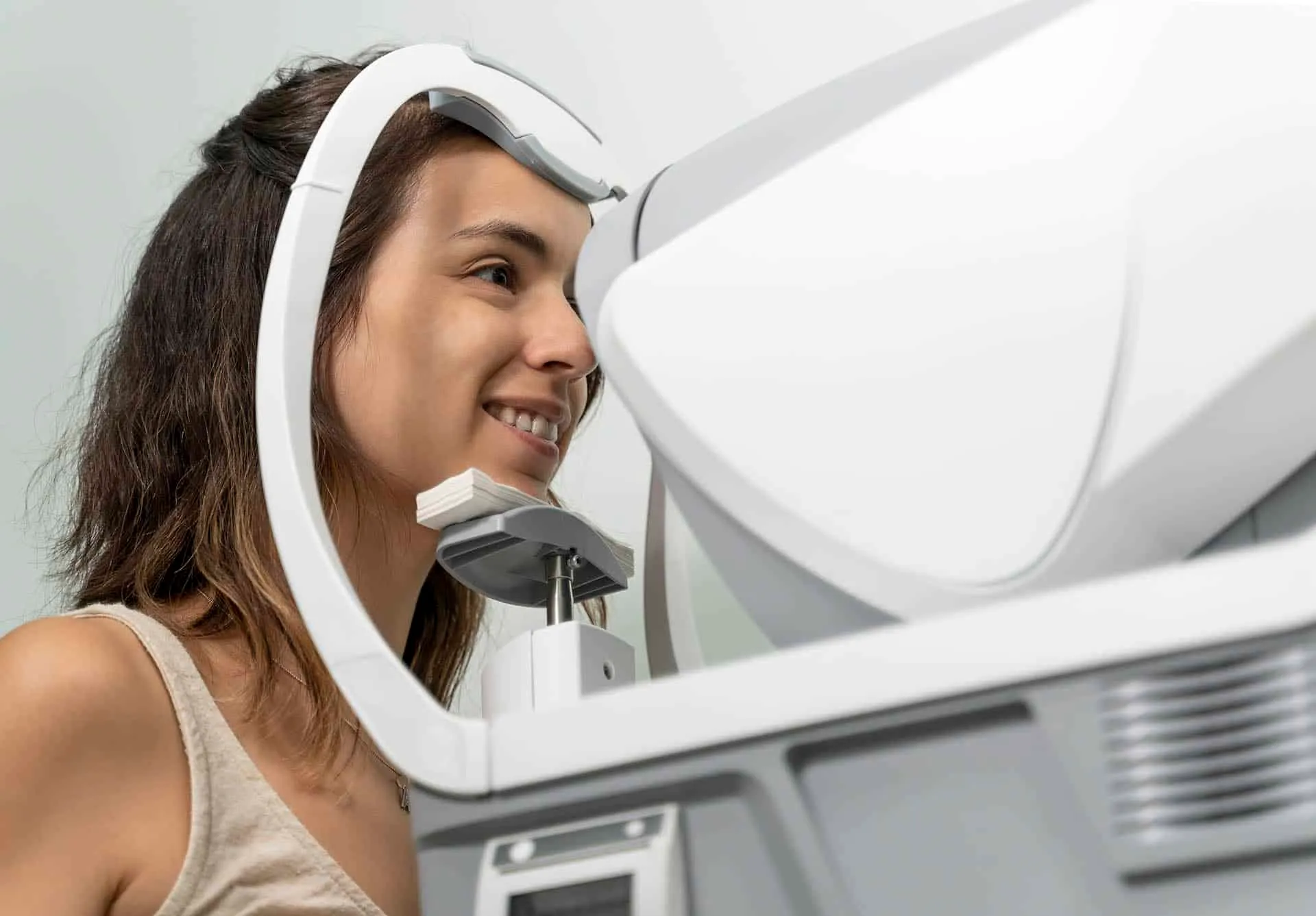

The intraocular pressure (IOP), also called eye pressure or eye strain, must be maintained at values that do not damage the optic nerve, resulting in irreversible vision loss.
Eye pressure can only be measured by an eye health specialist. Its measurement is painless and necessary, as pathological pressure often goes unnoticed by the patient, and the only way to prevent possible blindness is an assessment of eye and optic nerve pressure. It is usually taken routinely in ophthalmology clinics from the age of 40 onwards.
Intraocular pressure
The intraocular pressure is the force per unit area exerted by the fluids inside the eye, in the vitreous and aqueous humour. Among other functions, a correct eye pressure (between 10 and 20 mm Hg) helps to maintain the sphericity of the eyeball. When the pressure is high, it presses more intensely on the walls of the eyeball, with the possibility of damaging the optic nerve, which is the most sensitive part of the eye, thus causing glaucoma.
We can explain to the patient what intraocular pressure is and why the values of the home blood pressure monitor are useful to us with an analogy: while blood pressure measures the pressure exerted by blood on the walls of the arteries, intraocular pressure would be the equivalent of the force exerted by the air inside a balloon on the walls of the balloon, exchanging air for various aqueous fluids and balloon for eye.
It is not easy to determine whether eye pressure is pathological, i.e. causing damage to the optic nerve, or not, as there are eyes that can withstand pressures of up to 28 mm Hg without suffering damage, and others that at 18 mm Hg progress to optic nerve damage. It is therefore necessary to assess not only the pressure, but also the damage to the optic nerve through visual fields and optical coherence tomography of the optic nerve, family history, concomitant ocular pathology, etc. Periodic monitoring of the patient is very important to assess possible progression over time.
How is eye pressure measured?
IOP is measured with a special instrument called a tonometer. This device, which can only be operated by an ophthalmologist, applies gentle pressure to the cornea and sclera of the eye to measure the degree of deformation.
Tonometers work by flattening the cornea in a specific area, either with air or by contact. The pressure exerted to flatten this corneal surface is an indirect measurement of intraocular pressure. This is a quick, painless and bloodless measurement.
As with blood pressure, intraocular pressure values fluctuate throughout the day, so it is advisable to take measurements at approximately the same time each day, and may be temporarily altered by the use of certain drugs to treat other conditions.
Causes of increased intraocular pressure
Among the causes of the increase in pressure, we can highlight the following:
- Family history of ocular hypertension or glaucoma.
- Have high myopia or pathological myopia.
- Advanced age. From the age of 35 onwards, the risk of suffering from ocular hypertension increases.
- The use of certain drugs.
- Some eye diseases
Keys to avoiding high intraocular pressure
Genetic factors and the patient's clinical history are particularly relevant, and cannot be modified. However, we do have a therapeutic arsenal to lower ocular pressure, not only pharmacological but also surgical.
If, after starting a pharmacological treatment, you notice changes in your vision, consult a doctor immediately. This will not always be due to an increase in IOP and, if this is the case, your treatment will be changed or you will be referred to an ophthalmologist.
Otherwise, measures to keep intraocular pressure at optimal values that are within your reach are as follows:
- Go for an annual ophthalmological check-up, more often if the specialist tells you to do so, as high eye pressure is asymptomatic in its early stages and is the only way to detect it.
- Unfortunately, lifestyle habits have very little influence on intraocular pressure.
Treatments for normal intraocular pressure
Eye drops
Although steroid eye drops, when used for prolonged treatment, can cause intraocular pressure and glaucoma, other eye drops are used to treat less severe cases of these two conditions.
Some eye drops that help control high intraocular pressure contain prostaglandins to increase the outflow of fluid from the aqueous humour.
Others reduce fluid production inside the eyeball with beta-blockers.
Alpha-adrenergic agonists simultaneously reduce the production of fluid in the aqueous humour and improve drainage.
Eye drops containing carbonic anhydrase or rho kinase inhibitors or cholinergic agents may also be prescribed.
As you will see, there are many possible treatments, so it is not enough to go to a chemist's for advice and, of course, do not even think of using the eye drops that your neighbour has been recommended. Do not combine eye drops unless prescribed by your ophthalmologist and do not add other over-the-counter eye drops to your treatment.
Oral treatments
They are the next alternative when eye drops do not work. Eye drops are tried first because oral therapy to control intraocular pressure is often accompanied by more or less bothersome side effects. They are usually used temporarily before surgery, or in patients who are unwilling or unable to have surgery and eye drops are not sufficient to control the pressure.
Surgery
Depending on the patient, laser surgery, so-called filtration surgery or trabeculectomy, or placement of small drains in the eye may work.
Some patients with elevated intraocular pressure or glaucoma may benefit from specific, minimally invasive surgery that shortens recovery times.
The intraocular pressure is produced by the action of the fluids inside the eye. As with blood pressure, although they are not related, there are optimum values that should not be exceeded by either too much or too little. Elevated intraocular pressure is a silent enemy.It usually shows no symptoms until it has caused irreversible damage. This alteration in IOP is closely related to glaucoma. If you think you may be suffering from any type of problem or need to have your eye pressure measured, from the Dr. Nebro Ophthalmology Clinic We can help you, contact us and we will resolve your queries.